Boundary Artifacts in Interdisciplinary Engineering: Conceptualizing Rosetta Stones Between Domains
Sep 22, 2026·,,, ,,,,,,,,,·
0 min read
Thomas Alexander Voelk
Razieh Dehghani
Henriette Färber
Stefan Eric Schwarz
Romain Pascual
Lars Gesmann
Arne Lange
Leow Zi Le
Terru Stübinger
Melih Sah Dogru
Mattias Ulbrich
Tobias Düser
Anne Koziolek
Albert Albers
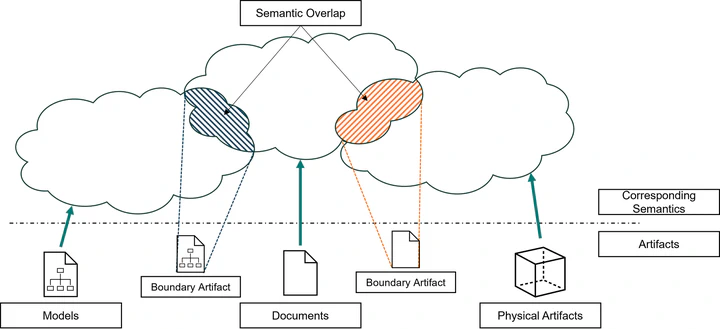 Boundary artifacts carry the semantic overlap between the domains of models, documents, and physical artifacts.
Abstract
In interdisciplinary engineering, collaboration often breaks down due to fragmented models, inconsistent terminology, and incompatible representations. Translating meaning between domains remains a significant challenge. While model-based systems engineering (MBSE) and other single underlying model (SUM) approaches offer structural support, they often lack the flexibility and scalability needed for dynamic, cross-domain work. A common bottleneck is the modeler. Translating domain-specific language into shared models is time-consuming and often only consistent with the actual project the moment its models are created. To enable MBSE (and other modeling approaches), we need “Rosetta Stones”: touchpoints between different epistemic domains combined in a single entity. This paper introduces boundary artifacts as such entities. They are intentionally designed to combine syntactic structure with semantic meaning. Unlike loosely defined boundary objects, boundary artifacts are purpose-built to support communication, coordination, and integration across disciplines. They can appear as parameters, diagrams, models, or documents, each containing overarching semantic overlaps between domains. The paper presents key hypotheses: boundary artifacts can help align viewpoints, support traceable decisions, and serve as anchors for shared meaning. We also discuss important features such as flexibility, robustness, and lifespan, and how these affect their usefulness in collaborative design. By formalizing the concept of boundary artifacts, this work offers a foundation for more scalable, resilient, and human-centered design practices. It supports both methodological development and practical use in complex engineering environments.
Type
Publication
2026 IEEE International Symposium on Systems Engineering (ISSE)